The short answer
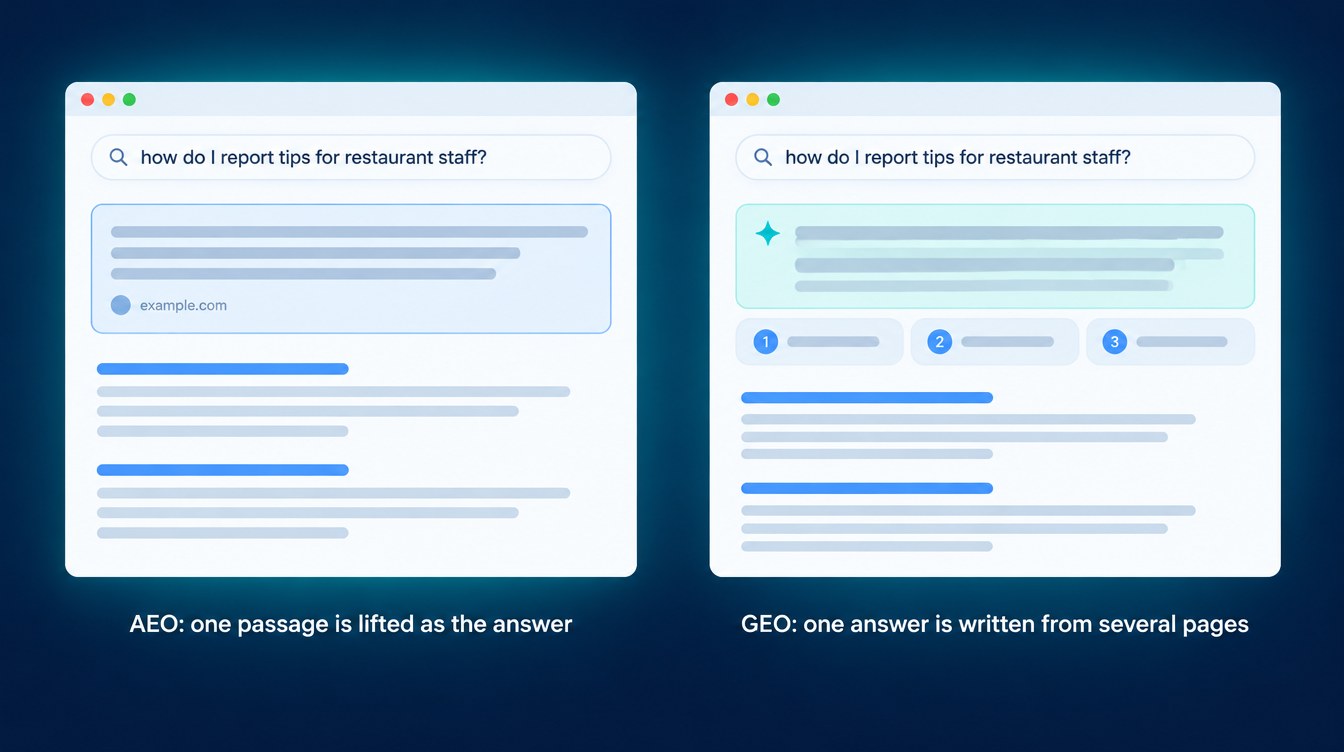
AEO and GEO share most of their work, which is why people use the terms for one thing. They differ in what the engine does with your page. AEO aims to be the passage an engine lifts and shows as its answer, while GEO aims to be a named source inside an answer the engine writes from several pages.
Key points
- Published guides define the two terms differently, with Jasper1 treating GEO as earning citations in AI answers and AEO as structuring content to answer questions directly, while Writer2 describes a single practice, which means the confusion starts in the vocabulary.
- AEO is the older idea, because Google's featured snippets3 have long lifted one passage from a page, and Google says a site owner cannot mark a page to appear as one.
- Google says AI Overviews and AI Mode have no technical requirements beyond normal search eligibility4, which keeps ordinary SEO as the base that both build on.
What do AEO and GEO each mean?
Answer engine optimization, or AEO, is the practice of shaping a page to let an engine lift a direct answer from it and show that answer in place of a list of links. The oldest example is the featured snippet, which Google describes as a box that shows the descriptive snippet first3, and Google states that its own systems decide which page earns one.
Generative engine optimization, or GEO, is the practice of earning a place in an answer that an AI model writes by combining several sources. Google describes its own AI Overviews and AI Mode as issuing several related searches across subtopics and data sources to develop one response, and that composing behavior is what GEO targets.
| AEO | GEO | |
|---|---|---|
| What the engine does | Lifts one passage and shows it as the answer | Writes a new answer from several pages and names some of them |
| Where you see it | Featured snippets and the related questions group in Google | AI Overviews, AI Mode, ChatGPT, Perplexity and Claude |
| What gets chosen | A passage from one page | A source, and the claims in it that the model decides to use |
| What you work on | The page and its sections | The page, the brand and what other sources say about you |
| How you check it | Search the question and look at the result | Ask the engine the question repeatedly, because the answer is generated each time |
The last two rows of the table are our judgment from how the two systems behave, and the first three follow from how Google describes its featured snippets and AI features.
Why are AEO and GEO used interchangeably?
The first reason is that the published definitions disagree. Jasper's guide gives GEO the job of earning visibility and citations in AI-generated responses and gives AEO the job of structuring content to answer questions directly. Writer's guide describes the two as one practice of making ChatGPT, Perplexity, Google AI Overviews and Claude cite and recommend you, and Archetype5 presents them as two separate disciplines. A reader who compares three guides gets three different boundaries, and reasonably concludes that the boundary does not matter.
The second reason is that the products no longer sit on one side of the line. Google runs featured snippets and AI Overviews in the same Search product, and a definition that sorts engines by platform therefore fails, since one platform does both. Sorting by what the engine does with the page holds up better.
The third reason is that the raw material overlaps. A page that opens with a clear answer, uses headings that match real questions, cites its figures and shows its date serves both approaches, which is why we run them as one service on our Discoverability page. Shared inputs do not make the outputs identical, however, and treating the two as the same hides decisions that really do differ.
What actually differs between them?
Three differences change what you would write or measure.
The engine extracts in one case and composes in the other. Extraction rewards a passage that stands alone, answers the question in its first sentences and still makes sense when quoted without the page around it. Composition rewards a page that contains something the model wants to include and attribute, such as a figure, a named source or a quotation from someone credible.
The contest is different. Extraction usually has one winner per question and behaves like classic ranking. Composition lets several sources feed one answer, and Google says its AI features display a wider and more diverse set of supporting links than a classic web search. The contest is therefore for inclusion among several sources more than for first place, which is our reading of how the system behaves.
The measurement is different. A featured snippet is visible to anyone who searches the question, and Google reports sites in AI features inside the Web search type in Search Console4, mixed in with ordinary results. A generated answer has to be sampled by asking the question several times in several engines, since the wording and the sources change from one run to the next.
What stays the same for both?
Both depend on a page that an engine can fetch, read and trust. Google states that the technical requirements for AI Overviews and AI Mode are the same as for Search in general, meaning the page must be indexed and eligible to show with a snippet, and that its usual SEO guidance applies. Crawl access, internal links, text that is readable as text and structured data that matches the visible page all carry over unchanged.
That is why SEO remains the base. An answer cannot be lifted from, or cited out of, a page that was never crawled, and Google's own guidance lists no special step for AI features beyond doing the fundamentals well.
How should a company act on the difference?
Start with the page-level work that serves both, because it is cheap and it comes first. Put a complete answer to the page's own question in the opening sentences, write headings as the questions people ask, and keep a visible date that you update when the content changes.
Then add the work that serves generation. Replace general claims with figures that name their source and year, quote a credible person where one exists, and link to the primary document instead of a summary of it. These changes give a generative engine something specific to attribute, and they are also what a careful reader wants.
Finally, check the result by asking. Choose ten questions your buyers ask, put each to several engines once a month, and record whether your domain is cited. The record shows which of the two jobs is failing, which a ranking report cannot do.
What would change our view?
The evidence for GEO tactics is thinner than the confidence around it. The advice here rests on how the engines describe themselves and on our own judgment, and we have not run a controlled test of it. Engines also change their models and retrieval often, which means a tactic that raises visibility in one quarter may do less in the next.
The claim that the brand and the wider web matter more for GEO than for AEO is our judgment from how generative engines gather sources, and we have not tested it against a controlled benchmark. If the vendor definitions settle on one meaning, or if engines begin to blend extraction and composition so thoroughly that the distinction stops predicting anything, a single term would serve better and we would stop separating them.
Sources
Figures last checked on October 19, 2026. Engines and guidance change often, and we revisit this article quarterly.
- 1 Jasper, “What is Generative Engine Optimization? GEO vs AEO vs SEO Guide 2026”. Updated October 8, 2026. A vendor guide, cited for how the terms are defined.
- 2 Writer, “GEO, AEO, and SEO in 2026: The enterprise guide to AI visibility”. July 28, 2026. A vendor guide, cited for how the terms are defined.
- 3 Google Search Central, “Featured snippets and your website”. Last updated December 10, 2025.
- 4 Google Search Central, “AI features and your website”. Last updated December 10, 2025.
- 5 Archetype, “Answer-Engine Optimisation vs Generative Engine Optimisation”. June 23, 2025. An agency guide, cited for how the terms are defined.