The short answer
ChatGPT ads are growing quickly and remain unproven. OpenAI and its measurement partners report strong early results and falling prices, while advertisers in public threads describe high costs and few conversions, and independent testing has only begun. Most of the evidence so far is anecdotal or comes from parties that benefit from the channel.
Key points
- OpenAI began testing ads on February 9, 2026 and opened a self-serve Ads Manager on May 5, and Graphite reports1 that the business reached a $1 billion annualized revenue run rate within 200 days of launch.
- Prices have fallen from a $60 CPM at launch to as low as $25 by April, according to Digiday2, and OpenAI suggests starting click bids at $3 to $5.
- Advertisers on Reddit's r/PPC3 report mixed or poor results, including one whose cost per click ran about 2.5 times Google's with no conversions, although the reports are small, self-selected and unverified.
- Measured, which is running incrementality tests with OpenAI, says it is too early to share results4 and advises treating the channel as test-and-learn spend.
- Ads reach only Free and Go users, which a marketer quoted by WordStream5 calls a problem for B2B companies.
What are ChatGPT ads, and where do they stand?
ChatGPT ads are paid placements that appear below an answer, labeled as ads and separated from the answer itself, and only for people on the Free and Go plans. Advertisers do not bid on keywords. They write one or two sentences, called context hints, that describe the situation their ad fits, and OpenAI matches those hints to the conversation by meaning, according to WordStream's guide5. Ads are sold in a relevance-weighted second-price auction on views or clicks, and a conversion objective still bills per click.
The channel has moved fast. Graphite and Similarweb6 found that 43 percent of ad-eligible US users had seen an ad six months in, and that tens of thousands of advertisers have tried it, with B2B SaaS the largest category.
| Date | What changed |
|---|---|
| January 16, 2026 | OpenAI announces that it will sell ads in ChatGPT |
| February 9 | A US pilot starts with large partners, bought by CPM only, at a $60 CPM and a minimum commitment that reports put at $200,000 to $250,000 |
| April | CPMs fall to as low as $25 and the minimum drops to $50,000 |
| May 5 | A self-serve Ads Manager opens with CPC bidding, a tracking pixel, a Conversions API and no minimum spend |
| October 5 | OpenAI announces a visual ad format, more measurement partners and geo-based incrementality experiments |
The dates come from WordStream5, Digiday2, AdExchanger7 and OpenAI8, and the two outlets disagree on the size of the original minimum.
What are advertisers saying?
The loudest public signal is a thread on Reddit's r/PPC. The original post, from an advertiser running campaigns in Europe, is a practical guide instead of a complaint. It tells readers to budget by the number of free-tier users, to write uncomfortably specific context hints, to write ads that continue the answer instead of repeating a search ad, to test many variants and to install OpenAI's measurement pixel before spending. The poster said an AI tool wrote up the sentences from his own notes, and one reply dismissed the post on that basis.
The replies carry the skepticism. One advertiser reported spending about $2,000 with no response and blamed the audience, since people on the free plan are by definition people who decline to pay a modest subscription. Another said costs per click and per thousand impressions were high, that the cost per click ran about 2.5 times Google's for the same products, and that no conversions followed, which in their view made the budget better spent elsewhere. A third said click prices still looked too high for performance work. The poster answered that click prices in Europe had been reasonable compared with what he had heard about the United States.


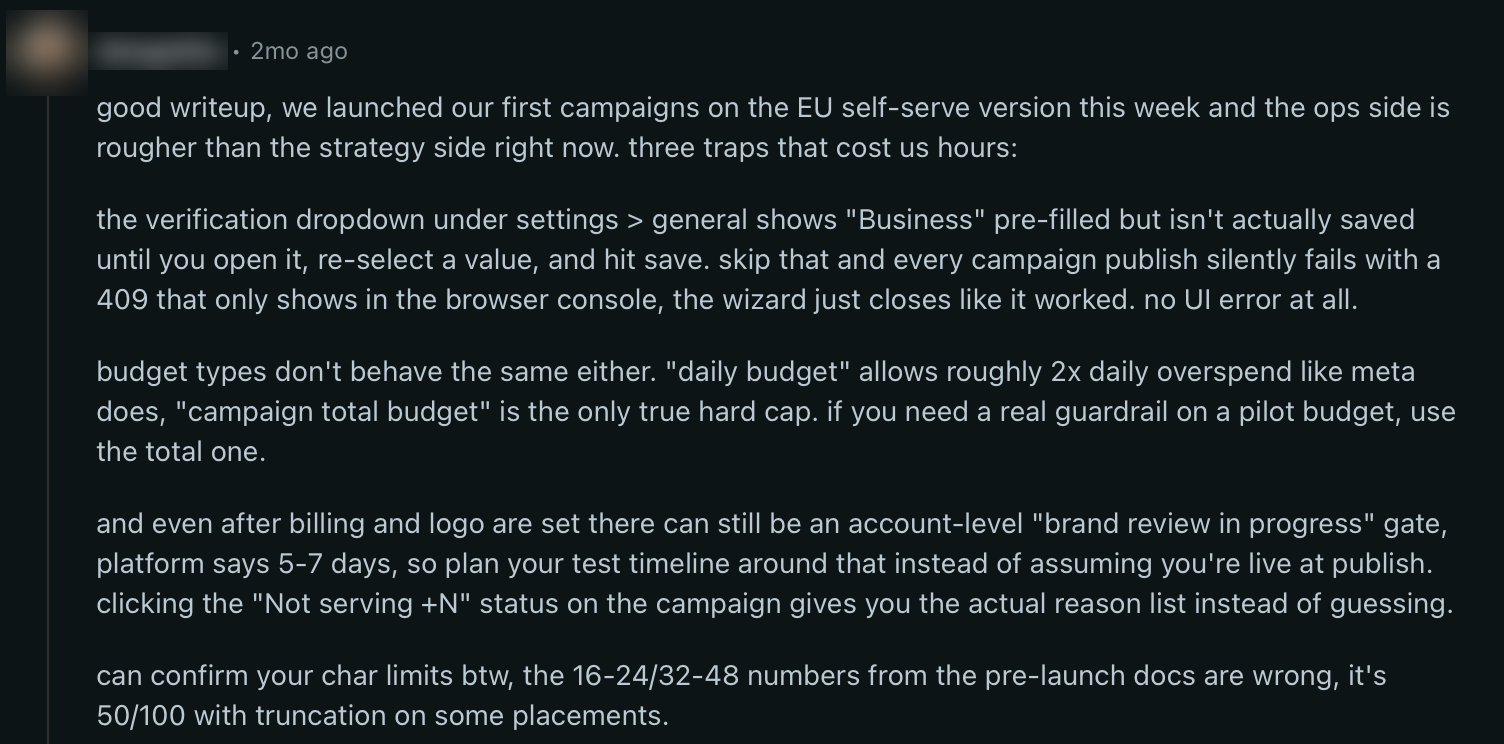
Other replies questioned the evidence itself. One commenter argued that a small test cannot show what works and that the advice repeated basics. Another speculated that OpenAI keeps prices high to limit the number of advertisers while it tunes its auction. A different group described the work of getting an account live. One advertiser listed three traps in the European self-serve beta. A business verification setting looks filled in but is not saved until it is reselected, which makes every campaign publish fail silently. Daily budgets can overspend by roughly double, while the campaign total budget acts as a hard cap. An account-level brand review that the platform says takes five to seven days can also hold up a launch. Several international advertisers said they could only target their country of business registration, that verification ran past a week and that support was slow to respond. One reply suggested checking that the website does not block OpenAI's crawlers, since the verification process reads the site.
WordStream's summary5 of Reddit discussions points the same way, describing a mixed bag that runs from cheaper clicks for local services to low-quality leads and platform glitches, and one advertiser whose visitors stayed about five seconds. These are anecdotes. Reddit threads over-represent people who are unhappy or who want to compare notes, the budgets are small, and none of the figures can be checked.
What do the independent numbers show?
No independent source yet shows the return on ChatGPT ads across advertisers, and each source below has a limit that belongs beside its finding.
| Source | What it reports | Caveat |
|---|---|---|
| Graphite and Similarweb | Click-through rates up 112 percent since launch, and Google still carrying far more volume | Graphite is a marketing firm, and the report advises experimental budgets |
| OpenAI's partners | One retailer's attributed cost per acquisition 15.3 percent below its paid search benchmark | Chosen and published by OpenAI, and attributed instead of incremental |
| Measured | Too early to share results from its incrementality tests | A measurement vendor that works with OpenAI |
| Digiday | CPMs falling, and a doubt about independent verification | Reported in April, before self-serve |
| Reddit r/PPC | Costly clicks and few conversions | Small, self-selected and unverified |
OpenAI's own announcement on October 5 adds two more partner results, a statistically significant lift for a wellness brand, 67 percent of whose incremental purchases came from new customers, and a retailer whose ChatGPT visitors were 93 percent new. OpenAI itself says its work on incrementality is still in its early stages. Digiday's April report quotes a consultant who put the central problem plainly, saying that until someone independent can verify what a ChatGPT impression delivers, advertisers take OpenAI's word for it.
Prices are the clearest improvement. A CPM of $25 to $45 is still high next to the Facebook, Instagram and TikTok figures that Digiday cites, which sit between $3 and $8. It compares more closely with LinkedIn at about $39, which B2B advertisers have long accepted because of its audience. AdExchanger reported in May that even advertisers who accepted the early minimums had trouble spending them, because the platform lacked inventory.
Why do the reports disagree?
Five differences explain most of the gap between the optimistic and the pessimistic accounts.
The tests are small and short. A budget of a few hundred or a couple of thousand dollars produces too few conversions to separate a weak channel from a noisy week, and Measured says it will not publish benchmarks yet for the same reason.
The markets differ. Prices and inventory vary by country, and the Reddit poster's experience in Europe is not the experience he reports hearing about in the United States.
Category fit varies. WordStream's expert sources expect travel, retail and home services to suit the channel because people already use ChatGPT to plan and compare, and one adds that free-tier-only reach is a handicap for B2B marketers.
Measurement was late. The tracking pixel and Conversions API arrived with the May self-serve launch, and conversion-optimized campaigns still bill per click, which means early results often rested on clicks alone.
The platform keeps changing. Measured warns that a test run months ago may not reflect how the channel performs now, and OpenAI has added formats, bidding options and measurement partners since the pilot.
What does this mean for a B2B company?
Our reading is that ChatGPT ads deserve a capped experiment and a decision rule, and that they do not yet deserve a place in the core budget. That matches the advice of Graphite and Measured, both of which suggest experimental spend, and it follows from what B2B buyers do, since Forrester's 2026 survey of nearly 18,000 business buyers9 found that 94 percent used AI during a purchase. This article summarizes public reports and does not draw on client results. A sensible test would include five things:
- A working measurement setup before the first dollar. The pixel and Conversions API are what let OpenAI's system learn from conversions, and the Reddit poster, Measured and WordStream all say to install them first.
- A stop number agreed in advance. WordStream suggests testing one service in one location under a fixed budget cap, with a clear keep-or-stop figure.
- Specific hints and copy that continue the answer. Graphite found that top advertisers write almost entirely new copy for the channel, which fits the poster's advice to write the next answer and not a search ad.
- A geographic holdout if spend grows. Measured recommends never scaling a new platform without a geo test running alongside it.
- A check on crawler access. The commenter's tip about blocked AI crawlers applies beyond ads, because the same blocks can keep your pages out of AI answers.
Buying ads also does not change what ChatGPT recommends. OpenAI says advertising does not influence the answers it provides, which leaves being named in an organic answer as a separate job. It depends on your pages and on how other sources describe you, and we cover it in AEO or GEO.
What would change our view?
Independent incrementality results from the geo experiments that OpenAI has set up with Haus, Measured and WorkMagic would matter most, because they would show whether ChatGPT ads create sales that would not have happened anyway. Lower prices at scale, targeting that reaches paying users, or a B2B-specific format could also move the case in either direction.
Our sample is limited. One Reddit thread of roughly three dozen replies is not a survey, the positive partner results were published by the platform, and we have read public reports only. The picture could look different within a quarter, given how fast the product is changing.
Sources
Figures last checked on October 28, 2026. ChatGPT advertising is changing quickly, and we revisit this article monthly.
- 1 Graphite and Similarweb, “The State of ChatGPT Ads”. September 28, 2026. Analysis of more than 98,000 ads. Graphite is a marketing firm.
- 2 Digiday, “‘Everything is coming down’: ChatGPT ads are getting cheaper”. April 17, 2026.
- 3 Reddit, r/PPC, “ChatGPT Ads: What I’ve Learned From Running Real Campaigns”. Posted about two months before our October 28, 2026 reading, with replies continuing into October. Anecdotal reports from individual advertisers, summarized here and not independently verified.
- 4 Measured, “The ChatGPT Ad Platform is Evolving Fast. Here’s How Brands Should Approach Measurement.”. October 7, 2026. A measurement vendor that works with OpenAI.
- 5 WordStream, guide to ChatGPT ads covering pros, cons, costs and who should try them. Last updated October 14, 2026.
- 6 Search Engine Land, “Report: ChatGPT Ads are growing fast, but advertisers are still figuring them out”. September 29, 2026.
- 7 AdExchanger, coverage of OpenAI’s self-serve Ads Manager and measurement launch. May 5, 2026.
- 8 OpenAI, “New ways to buy ChatGPT ads”. May 5, 2026.
- 9 Forrester, “The State Of Business Buying, 2026”. January 2026. Survey of nearly 18,000 global business buyers.
- 10 OpenAI, “Building advertising for the way people use AI”. October 5, 2026. A platform announcement, and the partner results in it were chosen by OpenAI.
- 11 OpenAI Help Center, “Ads in ChatGPT: The Basics”. Source for bidding, the auction and the suggested starting bid.